A Journey over Many Years

It all happened a long time ago probably in the 1980’s.  When my daughter was about 12 years old she wanted her bedroom to have a new, grownup look.  We researched various different styles, added some new furniture and found the perfect picture for the wall.  It was a print called “The Four Seasons” by Alphonse Mucha.  I knew practically nothing about him, other than I wasn’t sure how to pronounce his name and that he was born somewhere in Europe.

Four Seasons by Mucha

Over the years I had a love affair with that print which inspired me do some research.  I discovered Mucha did a lot of posters for Sarah Bernhardt and was considered Art Nouveau.  I had seen Mucha calendars in bookstores and sometimes saw his posters being used in advertising various products.  I felt I was becoming addicted to Mucha!

Now we move forward to December, 2008.  Our first trip to Prague.  Before travelling there I browsed the internet to learn more about the city and what it had to offer.  Imagine my delight to find out there was a Mucha Museum in Prague.  I told Michael it was definitely on the list to go and see!

Once in Prague, we located the museum on a map, figured out what Metro to take and off we went (see link at the bottom of this posting for instructions and map).

I learned so much about Mucha through the exhibits in the museum.  He was born in Southern Moravia (Czechoslovakia) in 1860.  As a young man, Mucha spent a great deal of time in Paris (1887 – 1904) where he did art work for Sarah Bernhardt.  Many examples of his art work was on display.  Of course  seeing the first Four Seasons (which was a little different from the one that my daughter had in her room), was a highlight.  Also on exhibit were several decorative panels which showed his conception of Art Nouveau.  I believe Mucha would be considered the Father of Art Nouveau.

Pages from his Parisian sketchbooks, never exhibited before, can also be seen.   Examples of decorated books are found in the show cases. The work he created  consists of posters, drawings and oil paintings. At the end of the exhibition I saw what Mucha’s studio in Paris must have looked like, with some of the original furniture, photos of his family and a set of photographs taken in the studio.  A half hour long documentary film about the life and work of the artist is also a part of the exhibition, which really answered many of my questions. I found it interesting that his family still runs the Museum.

Here is a site that shows some examples of his art work: http://arthistory.about.com/od/from_exhibitions/ig/mucha_belvedere/

After many repeated invitations to visit the United States, Mucha finally accepted an invitation and went to the United States in 1904. For a time he was the guest of President Theodore Roosevelt and his family. While there, Mucha made portraits of some of  the most important American families and also of well-known actresses, like Ethel Barrymore, Maude Adams, and others. He also had exhibits in New York and Chicago.  In addition to Mucha’s many works of art, he was asked by the government to organize art education in the United States. He assisted in this and also taught art classes to hundreds of students.

Between 1904 and 1913 Mucha visited America six times, hoping to accumulate enough capital to begin work on his painting of the (now famous) Slav epic and to insure the future of his family.

According to Wikipedia:   “When German troops marched into Czechoslovakia in the spring of 1939, Mucha was among the first persons to be arrested by the Gestapo. During the course of his interrogation, the aging artist fell ill with pneumonia. Though eventually released, he never recovered from the strain of this event, or from seeing his homeland invaded and overcome. He died in Prague on 14 July 1939, of a lung infection, and was interred in the Vysehrad cemetery.”  Michael and I visited this famous cemetery, but the snow kept me from finding all the gravesites I wanted to see.  As a note of interest,  Vysehrad cemetery is full of famous people:  musicians, artists, poets, writers and, as I understand it,  NO politicians!

Slavin or common grave site in Vyselhrad cemetary, includes A. Mucha


This photo is of a later visit.  Mucha’s plague is located on the lower left of this central monument or “common” grave.

So, what started out as a poster on my daughter’s bedroom wall in Portland, Oregon, USA has taken me down many paths ending up in the Mucha Museum in Prague, the Czech Republic!

But the Mucha journey has not fully ended yet.  There is the Slav Epic yet to see.  It has been in the news most of this last year, becoming a very heated and  controversial issue of which I have dutifully followed.  Read all about it in my next posting!

NOTE: Address and directions to the Mucha Museum – http://www.pragueexperience.com/places.asp?PlaceID=614

Technorati Tags:

Mucha, museum, Four Seasons, Vysehrad cemetery, Prague

Praise for Prague

We, Karin and Michael, have been travelling over the last three months to USA, Ireland, England and Scotland.  All of our family and friends in those countries asked about Prague and why we liked it so much.  The long answer would be to refer them to this blog and all the places we have been.  The short answer, perhaps, is architecture.

Recently, Ricky Yates, a Prague expat, has posted on the same subject.  Since we have not been posting here I will refer you to his blog which includes some great photos:  Prague Architecture with its amazing variety of decoration

Now that we are back in Greece and settling into a stationary life we will begin posting more about our experiences in Prague and the Czech Republic.

Christmas Memories 2009

Last year, Michael and I spent our second Christmas in Prague.  Our first stay the year before was only a brief visit of 10 days whereas our second time was much longer — November through February.

Because we settled in, we decided to decorate our apartment for the holidays.  Of course it was on the cheap because we would not be taking anything back home with us due to luggage limitations.  We really did have fun going to the supermarkets and buying little things.  We visited Albert and Marks and Spencer for most of the decorations. 

streamers in our kitchen for Christmas

Streamers in the kitchen..

Christmas Table Cloth and star candle

Christmas tablecloth and star candle . . .

Xmas Decoration Michael's Stocking in Prague

Michael’s Christmas stocking goes with us every Christmas . . .

Our Christmas window lights in Prague

Two strands of lights . . .one in the living room, one in the bedroom.


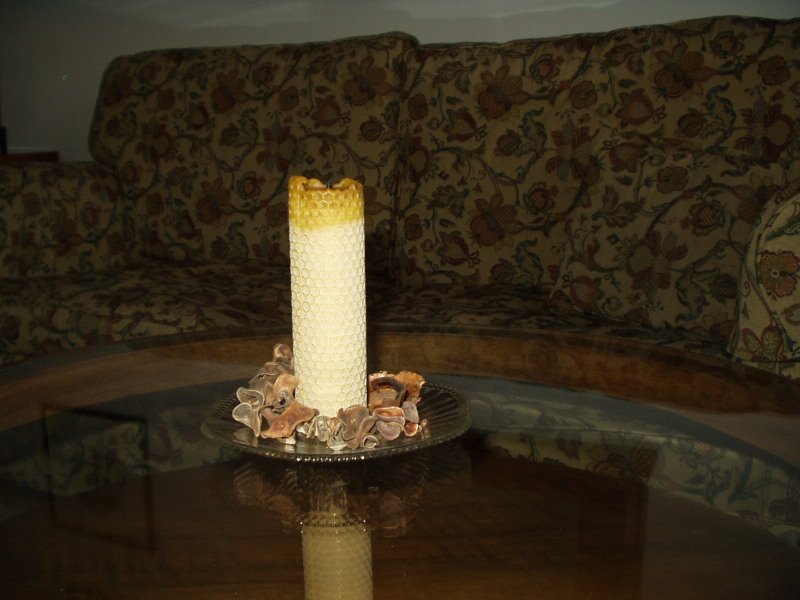
Xmas Decoration Honeycomb Candle from Prague Christmas market

A beeswax candle purchased at one of the Street Markets . . .

Christmas card display on antique in Prague

And we so appreciated the cards from friends . . .

A local supermarket called Albert gave out a monthly magazine with recipes.  I challenged myself to decoding them by using Google Translator so that our holiday season would be not only filled with decorations, but some traditional Czech foods as well.

Karin in kitchen cooking for Christmas, computer recipe

Where to eat on Christmas Day was a fairly large decision.  We remembered enjoying a delicious steak in Old Town the year before but the restaurant was no longer there.  So after going back and forth between this and that, we settled for dinner at the Indian Jewel located in Ungeldt Square.  It turned out to be an excellent choice!

Indian Jewel for Christmas dinner, Prague


And we are not too old to appreciate that Old Saint Nick (Santa Claus) visited us and left a few wee gifts, although we did think that just being in Prague was gift enough!

We are now talking about spending even a longer time in Prague next year, so we are definitely looking forward to another Christmas in the Czech Republic in 2011.

And this year our wish to all is a VERY MERRY CHRISTMAS!

Bila Hora or White Mountain

One snowy January day we decided to go to see where the Battle of White Mountain took place.  We found a map and saw a little dot in the middle of a large empty space just outside Prague.  (The little dot was suppose to be the monument to the Battle.)

From previous readings we learned this battle took place on White Mountain or Bila Hora in the Czech language.  It was an early battle of the Thirty Years’ War on 8 November 1620.  There an army of 15,000 Bohemians and mercenaries under Christian of Anhalt were routed by 27,000 men of the combined armies of Ferdinand II, Holy Roman Emperor.  The battle marked the end of the Bohemian period of the Thirty Years’ War.

Tram 22 would take us there.  Riding to the end of the line, we got off in a residential area with a lovely old church called P. Marie Vitezne and a date over the door that said 1713.Church of P. Marie Vitezne, Prague, Bila Hora


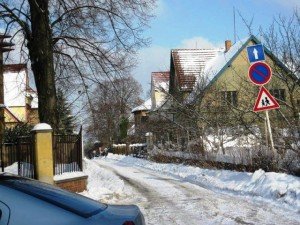
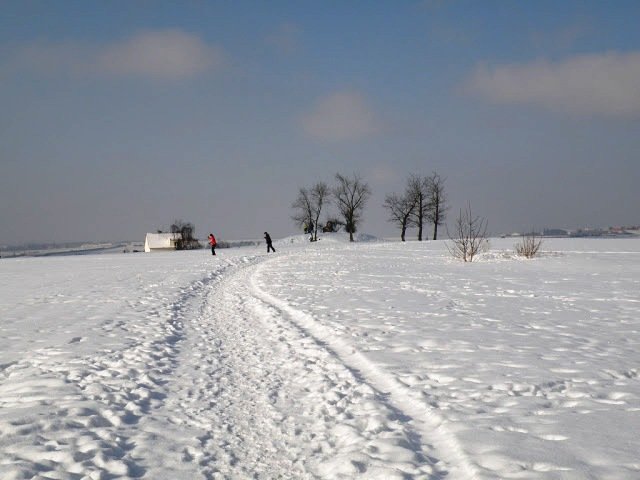
We followed the road from the tram stop through a housing area to a very large open area we could see in the distance.Housing area near Bila Hora, Pragueskiers at Bila Hora, PragueWe came to a huge open area with a couple of cross country skiers racing across and a rather small mound in the distance.  It was so cold and clear with the sun making all that white snow very sparkly and it dazzled the eyes!Snow fun at Bila Hora, Prague


Michael set off, walking to the Monument where a mother and 2 small children were having fun sledding down the slopes of the mound. Monument to Battle of White Mountain, Bila Hora, Prague


The monument, of course, is written in Czech but the dates were there so we knew we were in the right spot!  It was hard to imagine such a battle going on with horses, men and their weaponry; all fighting for their own cause.  They say the Battle only lasted 2 hours with much loss of life.  Hard to imagine because on this day, in January 2010, it was so serene!Rusne airport from Bila Hora, Prague


Looking towards the airport. . .Star Castle at Bila Hora, Prague


And looking towards the Renaissance summer palace built in the shape of a six-pointed star. It was built in 1556 for Archduke Ferdinand of Tyrol.  This palace was there when the Battle took place!Nice snow covered houses and streets, Bila Hora, Prague


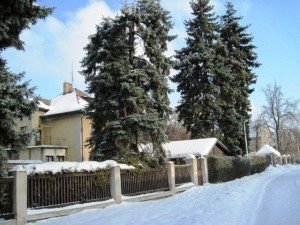
We walked through this neighborhood and on past the church to the tram stop.what a wonderful day!  I could even imagine myself living in this area . . . there is something very special about the country and open spaces and fresh clean air.